

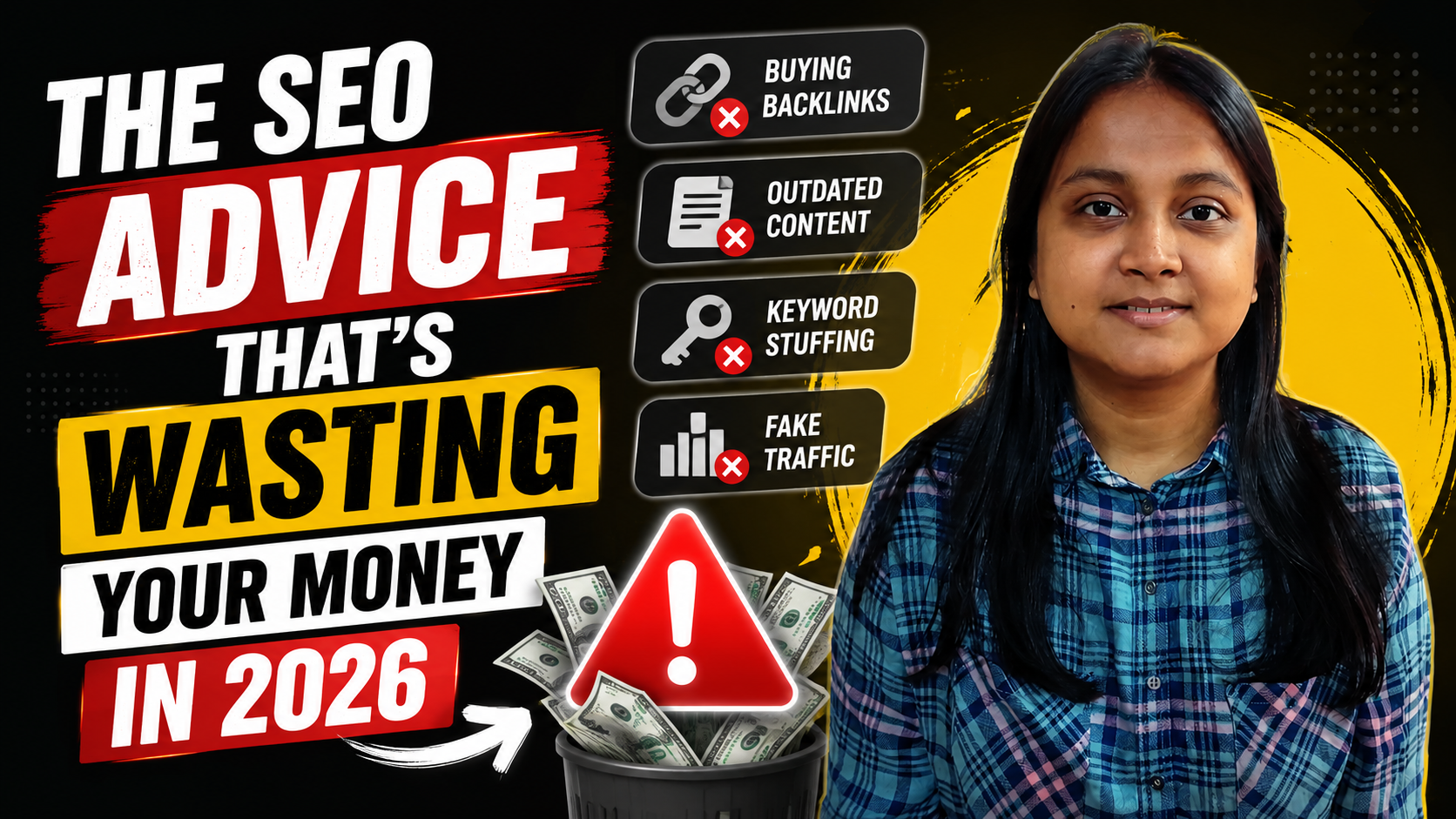
You’re probably paying for at least one of these right now.
Maybe it’s a “guaranteed rankings” retainer that quietly bills you every month. Maybe it’s a blog someone set up two years ago that still stuffs your business name into every other sentence. Maybe it’s a link-building package you signed up for after a cold email promised page one in 90 days.
Here’s the uncomfortable part: a lot of standard SEO advice was already outdated before 2026 started, and this year made it worse. Google shipped a spam update, a March core update, and a May core update — and AI Overviews now show up on roughly half of all searches, which means the “just rank #1” playbook doesn’t even guarantee a click anymore. If your SEO spend hasn’t changed in two years, it’s probably funding tactics Google has since learned to ignore, penalize, or simply route around.
This isn’t a pitch to scare you into a bigger budget. It’s the opposite — most of what’s below should let you spend less on the wrong things and get more from the right ones.
Contents
- 1 Myth #1: A backlink agency can “get you rankings”
- 2 Myth #2: Stuff your exact-match keyword everywhere
- 3 Myth #3: Bulk, AI-written content farms
- 4 Myth #4: Local SEO tactics from five years ago
- 5 Myth #5: Keyword density and other outdated on-page rules
- 6 Quick Checklist: Are You Doing These?
- 7 Where to Go From Here
Myth #1: A backlink agency can “get you rankings”
What it is. You pay a flat monthly fee, and an agency builds you a set number of backlinks — usually from a network of blogs, directories, or “guest post” sites you’ve never heard of.
Why it’s still pushed. It’s an easy sell. Backlinks are a real ranking factor, so the pitch sounds technically true, and the agency gets paid whether or not it actually moves your rankings. The incentive is recurring revenue for them, not results for you.
Why it wastes money. Google’s spam systems got faster and more aggressive in 2026 — the March spam update was the fastest confirmed rollout on record. Links from low-quality, clearly-for-sale networks are exactly what those systems are built to detect and discount. At best, you’re paying for links Google ignores. At worst, you’re paying for links that get your site flagged.
Do this instead. Earn a handful of links from sources that would mention you even if SEO didn’t exist: a local news writeup, an industry directory your customers actually use, a partner business linking to you. Five links like that beat five hundred from a link farm.
A common pattern small businesses run into: a $600/month “link building” retainer delivers a spreadsheet of 40 new links every month, rankings don’t move, and a manual review later shows most of those links sit on near-identical blog networks with no real visitors. The agency’s report looked productive. It just wasn’t measuring anything that mattered.
Takeaway: if a “backlink package” doesn’t name the actual sites you’re getting links from, assume it’s the kind Google is actively hunting.
Myth #2: Stuff your exact-match keyword everywhere
What it is. Cramming a phrase like “small business SEO Denver” into your title, headers, image names, and every third sentence, on the theory that repetition equals relevance.
Why it’s still pushed. It’s a leftover from 2010s SEO, and it’s easy to “prove” — you can literally count the keyword and show a client a number. Counting is simple. Writing something genuinely useful is harder to bill by the hour.
Why it wastes money. Modern ranking systems read for meaning and context, not keyword frequency. Worse, in an AI Overview era, robotic repetition makes your content less likely to get cited as a clean, quotable answer — and citation, not the blue link, is quickly becoming the thing worth ranking for. You’re paying a writer to make your content sound worse to both humans and the systems reading it.
Do this instead. Write the phrase naturally once or twice, and spend the rest of the effort on actually answering the question your customer typed in. If it reads awkwardly out loud, it reads awkwardly to Google too.
Takeaway: if a sentence sounds like it was written for a search engine instead of a person, it’s costing you both readers and rankings.
Myth #3: Bulk, AI-written content farms
What it is. Publishing a high volume of thin blog posts — often AI-generated with light editing — on the theory that more pages means more chances to rank.
Why it’s still pushed. Volume is easy to package and cheap to produce, so it scales well as a service. It’s a much easier pitch than “we’ll write four genuinely excellent posts this quarter.”
Why it wastes money. This is the myth 2026 punished hardest. One law firm relying on generic, formulaic articles saw its blog traffic cut in half within two weeks after a core update — the content simply didn’t clear Google’s bar for real expertise. You paid for the writing, the hosting, and the internal links pointing to those pages, and then paid again in the traffic you lost when the update landed.
Do this instead. Publish less, but make each post something only your business could have written — a real client scenario, a specific number, an opinion you’re willing to defend. Four strong posts a quarter will outperform forty forgettable ones, and they’re cheaper to produce than you’d think once you drop the ones nobody read anyway.
Takeaway: thin content isn’t a starter tier anymore — it’s a liability sitting on your site waiting for the next core update.
Myth #4: Local SEO tactics from five years ago
What it is. Citation-stuffing (submitting your business to fifty directories nobody visits), keyword-stuffed Google Business Profile descriptions, and city-specific landing pages that all say the same three sentences with the city name swapped out.
Why it’s still pushed. These are checklist tasks — easy to batch, easy to show as “deliverables” on a monthly report, regardless of whether they change a single ranking.
Why it wastes money. Local search now weighs real signals: genuine reviews with actual detail, consistent and accurate business information, and content that reflects an actual local presence. A directory listing on a site with no traffic and no relevance doesn’t move any of those signals. Duplicate city pages, meanwhile, tend to compete with each other rather than help.
Do this instead. Put the effort into your Google Business Profile itself — real photos, prompt responses to reviews, and posts about what’s actually happening at your business. If you serve multiple areas, write one genuinely different, useful page per area instead of a template with find-and-replace.
Takeaway: local rankings respond to evidence you’re a real, active business — not to how many directories know your phone number.
Myth #5: Keyword density and other outdated on-page rules
What it is. Old-school on-page checklists: hit a specific keyword percentage, use the keyword in the first 100 words no matter what, bold it a certain number of times.
Why it’s still pushed. These rules are checkable with a plugin, which makes them easy to audit and easy to bill for, even though the underlying assumption — that Google is running a percentage calculation — hasn’t reflected how ranking actually works for years.
Why it wastes money. You end up optimizing for a scorecard instead of for the person reading the page, or for the AI systems now summarizing your content into an Overview. Neither of those cares about your keyword percentage. They care whether your page actually answers the question clearly and quickly.
Do this instead. Structure the page so the answer is easy to find and easy to quote: a direct answer near the top, clear subheadings that match how people actually ask the question, and short, scannable sections. That structure helps human readers and gives an AI Overview something clean to lift — which is the new version of “ranking well.”
Takeaway: optimize for being the clearest answer on the page, not the highest keyword percentage.
Quick Checklist: Are You Doing These?
Run down this list. Any “yes” is a place your budget might be leaking:
- Paying a flat monthly fee for backlinks you’ve never seen a list of
- A blog written mostly to hit a keyword count rather than answer a question
- More than a few blog posts you couldn’t confidently defend in a conversation with a customer
- Multiple “near me” city pages that are copies of each other with the city swapped
- A content or SEO report that measures activity (posts published, links built) instead of outcomes (traffic, leads, rankings)
Two or more “yes” answers means it’s worth a second look at where that budget is actually going.
Where to Go From Here
None of this means SEO stopped working — it means the cheap, checklist version of SEO stopped working, right as Google got better at spotting it. With a limited budget, your money is better spent on a handful of genuinely useful pages, an accurate and active Google Business Profile, and links you actually earned, than on volume tactics built for an internet that doesn’t exist anymore.
The businesses coming out ahead in 2026 aren’t the ones spending the most on SEO. They’re the ones who stopped paying for activity and started paying for outcomes they could actually verify — more qualified calls, more form fills, more of the right customers finding them.
If you want a second opinion on where your current SEO spend is actually going, that’s a conversation worth having before you renew anything.