
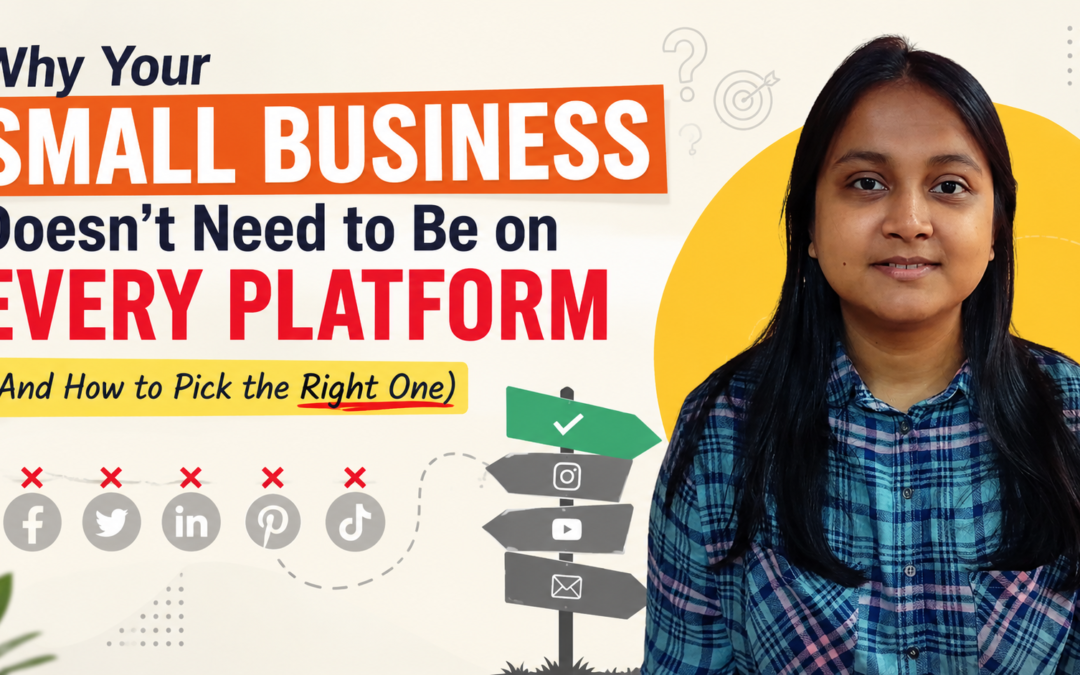
Somewhere along the way, “social media strategy” quietly turned into “have an account on Facebook, Instagram, TikTok, LinkedIn, and Pinterest, and post on all of them.” For a small team — or a business owner posting between everything else they do — that’s not a strategy. It’s five part-time jobs, each done badly.
Your business doesn’t need to be everywhere your competitors are. It needs to be excellent on the one or two platforms where your actual customers already spend time and where you can realistically keep showing up. A strong, consistent presence on one platform beats a thin, inconsistent presence on four — every time, for every business size.
This isn’t a workaround for not having enough resources. It’s how the businesses winning at this in 2026 actually operate. Facebook still reaches the widest audience overall, with the majority of U.S. adults using it regularly — but Instagram and TikTok dominate anyone under 30, LinkedIn is close to mandatory for B2B, and Pinterest quietly drives some of the highest-intent traffic in home, food, and fashion. No single platform serves every business, and no business needs all of them.
Picture two versions of the same local bakery. Version one has accounts on Facebook, Instagram, TikTok, and Pinterest, posts inconsistently on each because there’s only time to make content once or twice a week total, and none of the four ever quite gains momentum. Version two picks Instagram alone — because that’s genuinely where their customers browse and where photos of pastries do the most work — and posts there four times a week without fail. A year later, version two has a recognizable, active account with real engagement. Version one has four quiet ones. Same total effort, completely different outcome, because it went to one place instead of being divided four ways.
Contents
- 1 Why “Be Everywhere” Advice Persists
- 2 How to Actually Pick the Right Platform
- 2.1 1. Start with where your customers already are — not where you’d like them to be
- 2.2 2. Match the platform to the content you can actually sustain
- 2.3 3. Match the platform to how your customers actually buy
- 2.4 4. Start with exactly one platform, and don’t add a second until the first runs on its own
- 2.5 5. Judge platforms by engagement quality, not follower count
- 3 Signs You’re Already Spread Too Thin
- 4 A Quick Platform Cheat Sheet
- 5 FAQ
- 6 The Takeaway
Why “Be Everywhere” Advice Persists
Part of it is genuine FOMO — a competitor posts a viral TikTok and suddenly it feels like the platform you’re not on. Part of it is the businesses selling “full social media management” packages, where five platforms sounds like five times the value, regardless of whether your customers are actually on all five. And part of it is the platforms themselves, which naturally want every business to have an account, post often, and eventually spend on ads — they have no reason to tell you that your specific audience isn’t really there.
None of that is malicious. It’s just misaligned with what actually grows a small business: consistent, quality presence where your specific customers are looking, not maximum coverage everywhere they could theoretically be. Every additional platform also has a hidden cost that rarely gets factored in — a separate content format to learn, a separate posting rhythm to maintain, separate comments and messages to answer. Five accounts don’t just need five times the posting; they need five times the attention, and that attention comes out of the same limited hours as everything else in the business.
How to Actually Pick the Right Platform
1. Start with where your customers already are — not where you’d like them to be
This sounds obvious, and it’s the step most businesses skip. If you sell B2B services, your buyers are reading LinkedIn, not scrolling TikTok looking for a vendor. If you sell a visually driven product to people in their 20s, Instagram and TikTok are where the discovery actually happens. If your customer base skews 35 and older and local, Facebook still reaches more of them than anything newer. Write down who you’re actually trying to reach — age range, and what they’re doing when they’re likely to see you — before you pick a platform. A specialty B2B software company and a 24-year-old-founded skincare brand might both be “small businesses,” but almost nothing about where their customers spend time online is the same, and copying each other’s platform choice would waste both of their time.
2. Match the platform to the content you can actually sustain
TikTok and Instagram Reels reward frequent, ongoing video — if nobody on your team can realistically produce that every week, don’t build your whole strategy around a platform that punishes inconsistency. LinkedIn rewards written thought leadership and founder-led posts, which suits a business owner who can write but doesn’t want to be on camera. Pinterest rewards evergreen, well-designed static images that keep getting discovered months after you post them, which fits a product or home/food/lifestyle business better than a service one. Pick the platform whose native format matches what you can actually produce consistently — not the one that looks best in someone else’s case study. Be honest about capacity here: a solo owner who can write a thoughtful paragraph twice a week has a real shot at LinkedIn, and almost no shot at sustaining a TikTok posting schedule alongside everything else running the business.
3. Match the platform to how your customers actually buy
A long B2B sales cycle benefits from LinkedIn, where trust builds slowly through visible expertise over months. An impulse-driven visual product benefits from Instagram or TikTok, where someone can see it and buy within minutes. A local service business — a salon, a contractor, a restaurant — benefits most from wherever local customers already look things up and read reviews, which is still overwhelmingly Facebook and Google, not necessarily anything newer. The platform should match the actual path your customer takes from “notices you” to “buys from you,” not just where the most content gets made. A landscaping company chasing TikTok trends while its actual customers are searching Facebook and Google for someone nearby is optimizing for the wrong finish line — plenty of views, very few calls.
4. Start with exactly one platform, and don’t add a second until the first runs on its own
Pick the single platform your last two answers point to and commit to it for a real stretch — three months, minimum — before considering a second. That means a defined posting rhythm, a repeatable format, and enough consistency to actually judge whether it’s working. Adding platform two while platform one is still inconsistent doesn’t double your reach; it usually halves your effort on both and produces mediocre results everywhere instead of real results anywhere.
5. Judge platforms by engagement quality, not follower count
A thousand followers who never comment, click, or buy are worth less than two hundred who actually engage and occasionally become customers. When you do evaluate whether a platform is working, look at comments, saves, shares, messages, and — most importantly — whether it’s actually sending people toward a sale. Follower count is the easiest number to inflate and the least connected to revenue.
Signs You’re Already Spread Too Thin
A few honest questions to ask before adding another platform, or before deciding you need to:
- Can you name the last three posts you made on each platform you’re currently active on?
- Is at least one of your accounts posted to less than once a week?
- Have you ever posted the same content to three platforms at once just to “cover it”?
- Do you dread checking any of your accounts because there’s a backlog of comments or messages?
- Could you describe, in one sentence, who your ideal customer is on each platform you’re using?
Two or more “no” answers (or “yes” to the dread question) is a sign to consolidate before expanding — pick the platform that’s actually working and give the others a real pause rather than a slow, guilty decline.
A Quick Platform Cheat Sheet
- Facebook — broadest reach, skews 25+, still the default for local services and community-oriented small businesses.
- Instagram — strong for visually driven products and lifestyle brands, especially reaching audiences under 35.
- TikTok — best organic reach of any platform right now, skews younger and slightly female, ideal for businesses with a visual process or story to show, not just a product to sell.
- LinkedIn — close to mandatory for B2B and professional services; rewards founder-led, expertise-driven content over polish.
- Pinterest — a discovery and planning platform more than a social one; especially strong for home, food, fashion, and any product people research before buying.
If your business doesn’t map cleanly onto any platform on this list yet, that’s a sign to figure out where your specific customers actually spend time before picking one — not a reason to sign up for all five just in case.
FAQ
How many social media platforms should a small business be on?
For most small businesses, one platform done consistently and well is enough to start, with a second added only once the first is running smoothly. Being active on more than two or three platforms rarely makes sense without a dedicated content team.
What’s the best social media platform for a small local business?
Facebook is still the safest default for local businesses, since it reaches the widest range of ages and remains where most people look up and review local businesses. That doesn’t rule out a second platform if your customers clearly skew younger or more visual.
Is it bad to not have a TikTok account?
No — not if your customers aren’t the ones using it. TikTok is powerful for businesses with a younger audience or a visual process worth showing, but it’s not a requirement for every business, especially B2B or older-skewing customer bases.
How do I know if I picked the wrong platform?
If months of consistent posting produce little engagement, few clicks, and no real customer contact, that’s a sign the platform doesn’t match where your audience actually spends time — not a sign you need to post more often on it.
The Takeaway
Being on every platform isn’t a strategy — it’s a way to be mediocre in five places instead of strong in one. Figure out where your actual customers are, match the platform to what you can realistically produce, and give it real time before judging results.
If you’re currently maintaining three or four accounts and none of them feel like they’re working, that’s not a sign you need a sixth. It’s a sign to pick the one with the clearest overlap between your customers and your capacity, put your full effort behind it for a real stretch, and let the rest go quiet without guilt. That’s how small businesses actually grow on social media in 2026 — not by covering every platform, but by owning the right one.