
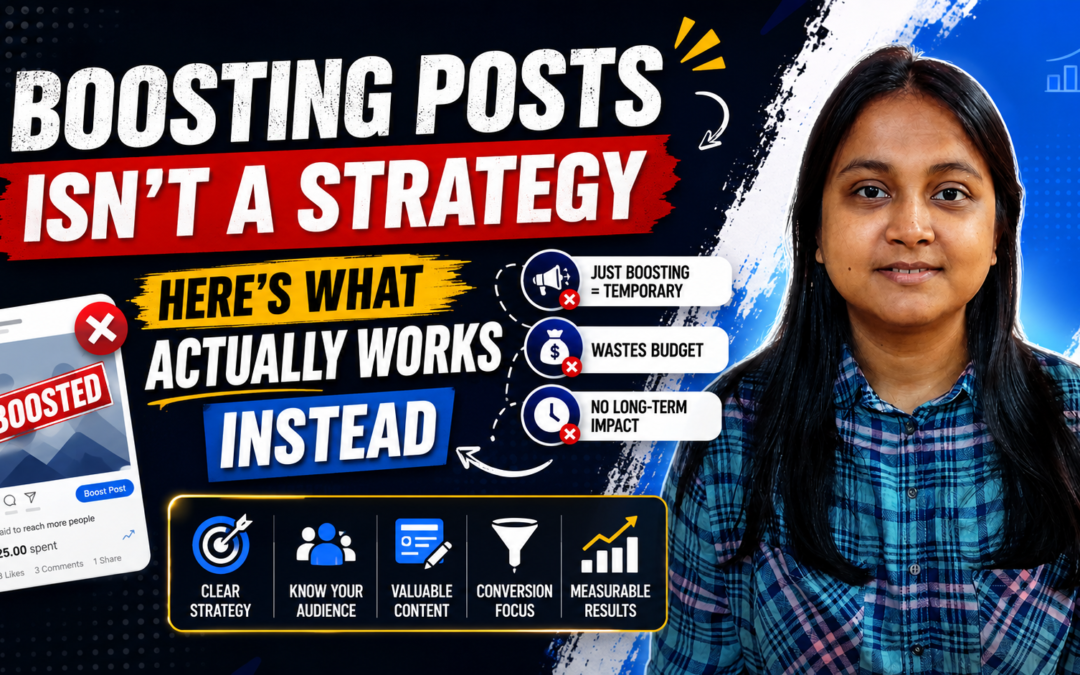
You wrote a good post. You hit the blue “Boost Post” button, put $25 behind it, and watched the likes tick up for three days. Then it stopped. No new leads, no repeat customers, nothing you could point to next quarter and say “that’s where it came from.”
That’s not a strategy. That’s a transaction — and it’s one of the most common ways small businesses quietly burn marketing budget in 2026.
Boosting a post pays the platform to show one piece of content to more people for a limited time. It doesn’t build an audience, a funnel, or a repeatable system, which is why the effect disappears the moment you stop paying. A strategy produces something that’s still working next month. A boosted post produces a memory.
This matters more in 2026 than it used to. Organic reach on most platforms has fallen below 5%, and on Facebook specifically it’s down to roughly 2% — so the instinct to throw a few dollars at a post to “get seen” is understandable. Algorithms have quietly shifted toward paid distribution for years, and the gap between “post and hope” and “post and pay a little” keeps widening. The problem isn’t spending money on paid social. It’s mistaking one button for a plan.
Contents
Why This Habit Is So Common
It isn’t an accident that “just boost it” feels like the default move. The Boost button sits directly under every post you publish, requires no targeting knowledge, and promises a result — more people reached — in exchange for a few taps and a credit card. Running an actual campaign, by contrast, means opening a separate ads manager, defining an audience, setting a goal, and waiting to see results. One of those is friction-free. The other requires a plan. Platforms benefit either way, since both routes end in ad spend — but only one of them tends to produce something you can build on.
Why Boosting Alone Doesn’t Work
It’s temporary
A boosted post buys attention for exactly as long as the budget lasts. When it runs out, reach drops back to baseline — and baseline, for most small business pages, is close to zero. You haven’t built anything that keeps working while you sleep; you’ve rented a few days of visibility, and the rent is due again next week if you want the same result twice.
It wastes budget
Most boosted posts weren’t chosen because they were proven to convert — they were boosted because they were available, or because someone felt the page had gone quiet. Without a clear goal (more calls, more sign-ups, more sales) and a specific audience behind that goal, you’re paying to show random content to a broad audience and hoping something sticks. That’s not targeting. That’s a donation to the platform.
It has no long-term impact
A real campaign leaves something behind: a retargeting list, data on what messaging worked, an audience you can reach again for free next time, content you can reuse. A one-off boosted post leaves you exactly where you started, minus the budget — you’ll be back at the same button next month, with no more insight into what works than you had today.
What Actually Works Instead
The businesses getting real results in 2026 aren’t choosing between organic and paid — they’re running both as one system: post organically to find out what resonates, then put budget behind what’s already proven to work. Here’s what that looks like in practice.
1. Start with a clear strategy, not a spare post
Before you spend a dollar, decide what the money is supposed to do. More booked calls? More newsletter sign-ups? More product page visits? A boosted post with no defined outcome can’t be judged a success or failure — there’s nothing to measure it against. Pick one goal per campaign and write it down before you touch the ad manager.
2. Know your audience before you pay to reach more of them
“Everyone in my city” is not an audience — it’s a budget leak. The small businesses getting the most out of paid social in 2026 are narrow on purpose: past customers, people who visited a specific page, followers of a handful of relevant accounts. A tightly defined audience of 5,000 people who actually want what you sell will outperform a loosely defined audience of 500,000 every time.
Take two versions of the same yoga studio boosting the same post. Version one targets “women, 25-55, within 15 miles” — broad, generic, competing with every other local business for the same eyeballs. Version two targets “people who visited our class-schedule page in the last 30 days but didn’t book” — narrow, specific, and made up almost entirely of people who are already one step from becoming a customer. Same budget, same post, very different outcome.
3. Test content organically first, then amplify what’s already working
This is the single biggest shift from the old “just boost it” playbook. Post content organically, let it run for a few days, and look at what actually gets saves, shares, comments, or clicks — not just likes. Then put budget behind that specific post. You’re no longer guessing which content deserves ad spend; the audience already told you.
A common comparison plays out like this: $200 boosted behind an untested post generates a wave of cheap clicks and zero sales, because nothing confirmed the content actually resonated first. The same $200 behind a post that already had strong organic saves and comments routinely turns into real leads — same budget, same platform, the only difference is which post earned the spend. Even $20-50 behind a post that’s proven itself organically will outperform $200 behind a guess.
4. Build every post toward a conversion, not just a view
Reach and impressions feel good on a screenshot and mean nothing on a bank statement. Every piece of content that gets paid support should have a next step attached — a link, a comment prompt that starts a conversation, a clear reason to visit your site. Compare “Here’s our new menu” with no link, to the same photo captioned “Full menu + online ordering linked below — table for two this weekend?” Same image, same budget, but only one of them gives the person looking at it something to actually do. If a post’s only job is to be seen, it isn’t doing a job at all.
5. Measure results, not vanity metrics
Likes and reach tell you a post was shown. They don’t tell you whether it made you money. Track what happens after the click: did they visit a key page, fill out a form, message you, buy something? A post with 10,000 views and no clicks did less for your business than a post with 400 views and 15 messages from interested customers — but a reach-only report would make the first one look like the win. If you can’t answer what happened after someone saw a campaign, you don’t actually know whether it worked — you just know it ran.
A Platform-by-Platform Note
Not every platform behaves the same way in 2026, so “what actually works” looks slightly different depending on where you post:
- Facebook has the lowest organic reach of the major platforms at roughly 2%, so treat any Facebook content you care about as a candidate for a small, targeted boost once it’s proven itself — not a default. Posting and hoping on Facebook alone, without any budget behind your best performers, means most of your existing followers will never see it.
- Instagram still rewards Reels and carousels organically far more than static image posts; post those consistently and boost only the ones that already have strong saves or shares once they’ve had a few days to prove themselves.
- LinkedIn rewards founder-led, personal-profile content especially well for B2B — a post from the owner’s personal profile routinely outperforms the same message from the company page. Occasional boosting of your best-performing posts, personal or company, stretches that further.
- TikTok currently offers the strongest organic reach of any platform, distributing content by interest signals rather than follower count. A brand-new account with zero followers can still reach a real audience — which means it deserves genuine organic effort before you spend a cent boosting anything there.
Quick Self-Check: Are You Just Boosting?
Ask yourself these before your next boost:
- Did I decide what this post should accomplish before I boosted it?
- Am I targeting a specific group of people, or “everyone nearby”?
- Did this post already show signs of working organically?
- Does this post lead somewhere — a link, a form, a next step?
- Will I check what happened after the click, not just how many people saw it?
If you answered “no” to two or more, you’re boosting — not running a strategy.
FAQ
Is boosting a post ever worth it?
Yes — but only after the post has already proven itself organically and you have a specific goal and audience behind the spend. Boosting a random post with no data behind it is the version that wastes money.
How much should a small business spend on boosting posts?
There’s no fixed number, but many small businesses see a measurable difference starting around $20-50 behind a single, already-proven post — far less than boosting untested content at a higher budget.
What’s the difference between boosting a post and running paid ads?
Boosting is a simplified, low-control way to pay for extra reach on an existing post. A paid ad campaign gives you full control over audience targeting, ad formats, placements, and conversion tracking. Boosting can be one small tactic inside a paid strategy — it isn’t a substitute for one.
Which social platform has the best organic reach in 2026?
TikTok, by a wide margin, because its algorithm distributes content based on interest signals rather than existing follower relationships — even brand-new accounts can reach a real audience without spending anything.
The Takeaway
Boosting isn’t the enemy. Using it as your entire strategy is. Pick a goal, know who you’re actually trying to reach, let organic posts tell you what’s worth paying for, and measure what happens after someone sees your content — not just whether they saw it.
None of this requires a bigger budget than you already have. It requires spending the budget you have on the post that already earned it, aimed at the audience most likely to act on it, with a way to know afterward whether it actually worked. That’s the difference between spending on social media and investing in it — and it costs the same $25 either way.